1. The universe
This is a balanced universe with 3 galaxy(ies) of 100 solar systems. Each system has 15 habitable orbits, plus orbit 16, deep space, reserved for expeditions. Speeds: production ×46.0, construction ×46.0, research ×42.0, shipyard ×42.0, fleets ×0.4. Time keeps flowing while you are offline.
2. Resources and deposits
Mines extract metal, crystal and deuterium from a finite deposit under each orbit:
- crystal is richer near the star (orbits 1 to 3);
- metal is richer in the middle belt (orbits 6 to 10);
- deuterium is richer on cold, distant orbits (14 and 15), where the synthesizer also yields more.
In this universe the rule holds in every system: chance sets the size of deposits, but orbits 1 to 3 always hold the most crystal, orbits 6 to 10 the most metal and orbits 14 and 15 the most deuterium.
An average deposit lasts about 273 days for a well-developed planet. An exhausted deposit produces nothing: relocate, colonise or trade. Energy powers the mines. Full storage stops extraction.
Balanced entropy: in this universe, metal, crystal and deuterium exist in fixed proportions (100 : 50 : 25). 25 % of each deposit is accessible from the start, the rest is released steadily until the universe’s planned end, 2027-08-09 (about 9 months); the part still locked cannot be mined. Every extraction (mines, extractors) also costs the deposit 10 % of permanent losses. The far universe (position 16) releases its reserve over time as well, found on expeditions and at the merchant.
3. Conservation of matter
Nothing is created, nothing is lost. The universe holds a fixed amount of matter. It always sits somewhere: in a deposit, a stock, a building, a unit, a fleet or its cargo, a construction in progress, a debris field, deep space, or a black hole. Any tampering is detected.
4. Buildings and research
Each level costs more than the previous one. A planet's queue holds 4 items, and research has its own queue for the whole empire. Cancelling is fully refunded. Demolishing costs the price of the removed level, minus 4% per Ion technology level, and takes its construction time. Part of the materials (30%) falls into orbit as debris; the rest disperses. The terraformer and the lunar base cannot be demolished, nor can a building another one requires, or a silo that still holds missiles. The research lab is shared by all your planets; the intergalactic research network cuts the resource cost of other research by 5% per level, up to 25% at level 5 (maximum level) — time and points stay those of the full price. The tech tree shows every requirement.
5. Shipyard and defences
Units leave the shipyard one by one. Shield domes are unique per planet. Interplanetary missiles destroy defences without combat.
6. Fleets
You can have 1 + Computer technology level fleets in flight at once. A fleet flies at the speed of its slowest ship, adjustable in steps of 10 %. Fuel follows OGame's formula: each ship type burns according to its own speed relative to the fleet's. Fuel travels in the holds with the cargo: cargo and fuel together cannot exceed the cargo capacity (probes also have a small 5-unit tank). Burnt fuel goes to deep space. Fleets can be recalled until they arrive, or while holding. See Movements.
Synchronised arrivals
With chronal physics and a temporal anchor on a moon, an attack, a moon destruction or an espionage mission can arrive at the chosen instant. The fleet flies, then waits in a space-time fold (12 h at most), never earlier than its fastest flight and never as a combined attack. Precision: ± 60 s at level 1, down to ± 1 s from level 10. Cost: dark matter per jump plus waiting deuterium (a tenth of the fleet's hourly consumption), reduced by the fold drive; the anchor then recharges (24 h at level 1, −20 % per level, 4 h minimum). Counterplay: a visible temporal signature, and the temporal jammer (+3 s of imprecision per level). The Chronarch sharpens precision and recharge, the admiral cuts waiting fuel, the defender strengthens jammers.
7. Combat
- A battle lasts up to 6 rounds, with rapid fire. Shots under 1 % of the target's shield bounce off. Units whose hull drops under 70 % may explode.
- The attacker plunders 50 % of the stocks, within cargo capacity.
- Defences are rebuilt at 70 %.
- Debris: 30 % of destroyed ships and 0 % of destroyed defences. The rest disperses into deep space.
- Moon chance: 1 % per 4,600,000 debris (100,000 at speed ×1, multiplied by production speed), up to 20 %. One moon per planet: a planet that already has its moon never gets another (combat, hidden moons, administration).
8. Espionage
Depending on the number of probes and the espionage technology gap, a report reveals resources, then fleet, defences, buildings and research. Probes may be shot down.
Geological surveys: the geological probe (shipyard 4, espionage 4, astrophysics 1) reveals the subsoil of any orbit from 1 to 15 (remaining and initial reserves), plus, for an inhabited planet, its richness, hourly extraction, days before depletion and whether you can move in. The more probes arrive, the more precise the survey (± 20 % with one probe, divided by the square root of the number of probes, exact from 100 probes; the true value always lies within the range). Water is detected from 2 probes, food from 3; from 5, the colonists a level 10 farm and pumping station would feed, the orbit’s quality and a viability verdict. The owner is notified; probes return home.
9. Expeditions
Colonists, food and water
Mines employ colonists (40 × level × 1.1level per mine). Jobs filled and colonists fed: normal output; twice as many colonists as jobs: up to +20%; understaffed or starving: down to −30%, never a stop. Farms and pump stations feed colonists (10 t food and 15 t water per hour per 1,000) and set the possible population, which grows by up to 8% per day toward that limit and slowly declines in famine (never below 200). A colony ship carries 250 colonists; transports and deployments move colonists, food and water; raiders also take supplies. At an empty tank, drinking water comes before farming. A full food store limits farm output to consumption. Life support stays outside the matter balance.
Expeditions go to orbit 16. You can run √(Astrophysics) of them at once, and they hold for 1 to 8 h. Possible outcomes: resources, ships, dark matter, pirates, aliens, delay, early return, or nothing. There is a 0.3 % black-hole risk (before the effect of duration and depletion): the fleet and its cargo are swallowed and removed from the game. Heavily used spots grow poorer.
10. Colonies, relocation, abandonment
- You can own 1 + ⌈Astrophysics / 2⌉ planets. A colony ship is dismantled on arrival and becomes the colony's first stock.
- Relocation moves a planet and everything on it for 30,000 dark matter, once every 24 h. The deposit stays with the orbit.
- Abandoning a colony self-destructs it into debris.
Moving into a ruined planet: a colony ship can take over an inhabited planet only if it is abandoned — owner inactive for at least 14 days and not on vacation, not their home planet, no building, defence, fleet or activity left, and an empty moon (which changes hands too). The ship is dismantled into the stock; both players are notified.
Alliance depot: the planet owner supplies deuterium to allied fleets stationed there (Movements page), extending their stay by 1 to 2 h per depot level per supply (16 h at most), within 64 h of remaining stay, for a tenth of their hourly consumption. The deuterium paid is burned.
11. Debris
Recyclers collect metal, crystal and deuterium. A field in orbits 1 to 15 that receives nothing for 72 h drifts to orbit 16 half of the time; otherwise it fades away, swallowed by the devouring black hole.
11 b. The devouring black hole
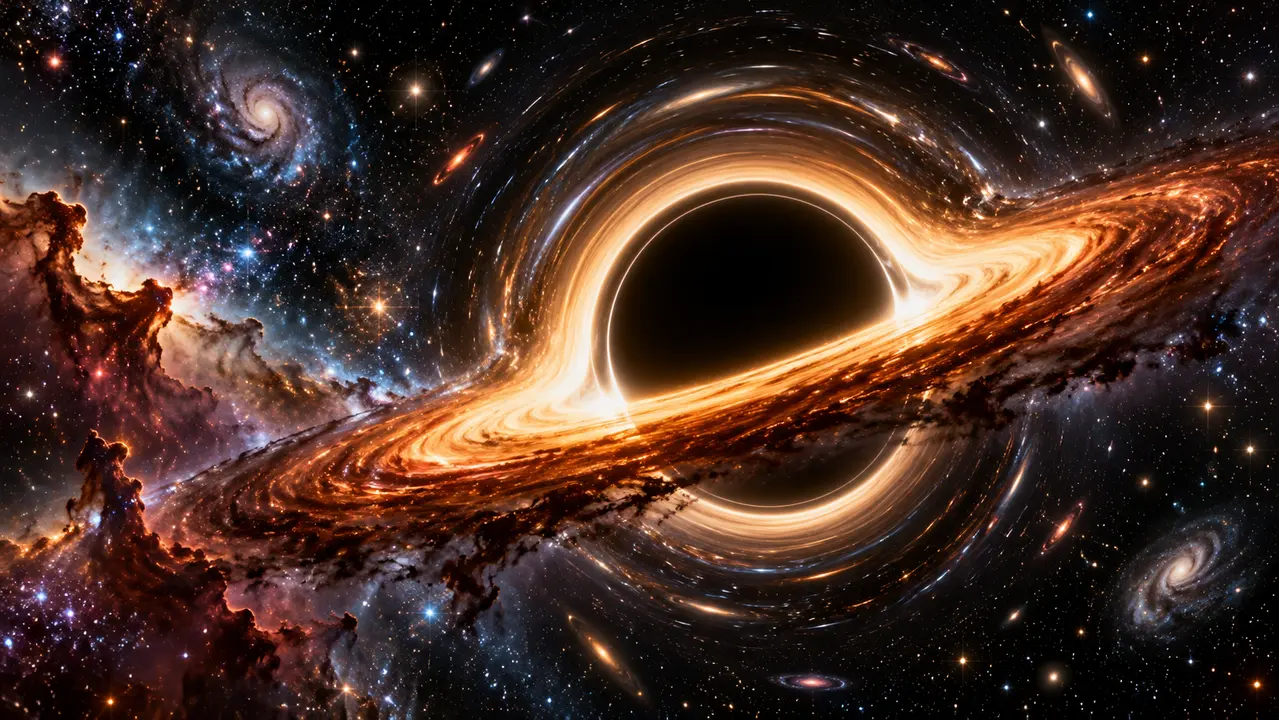
Nothing is created: every unit of matter in the universe is counted. But whenever matter disappears, the devouring black hole swallows it for good: what battles blow up without leaving debris, the holds of destroyed fleets, wrecks and cargo lost to pirates, fleets lost on expeditions (black hole, pirates, aliens), missiles fired and what they destroy, downed probes, Black Moons broken by a moon, unrecycled debris fading away, the materials of demolished buildings and, in a balanced-entropy universe, a share of every extraction. Burnt fuel and research materials do not disappear: they scatter into deep space, where expeditions and the merchant find them again.
12. Market
Treasure hunt: from time to time, the team places loot (pirates’ treasure, alien cache, resources washed up from a debris field…) on a free orbit, taken from the deposits of free orbits, and announces a hint. It belongs to whoever carries it away with cargo ships (“Treasure hunt” mission): each fleet takes what its cargo ships can carry, in one or several trips, by one or several players. A fleet that picks the wrong orbit comes back empty-handed.
Metal, crystal and deuterium trade freely. Supply and demand set the prices. Supply is everything the players (AI included) hold: the stocks of all their planets, colonies and moons, and the cargo of their fleets in flight, deep space included — never what still lies in the deposits (planet subsoil, free orbits). A resource’s price in metal is the metal held divided by that resource held: what players have in abundance is cheap, what is rare is dear; prices are 1 : 1.5 : 3 when players hold 6 metal for 4 crystal and 2 deuterium. Nothing is created: what the merchant gives you comes out of the deep-space reserve, what you give goes into it; an empty reserve has nothing to give. Each order moves the price — what you buy gets dearer, what you sell cheaper, the more so for a large order — and the effect then fades (halving in 8 h); splitting an order gains nothing. Even without trades, prices swing slowly by a few percent, each resource at its own pace. Prices stay within a band: against the other resources, a resource is worth at most 3 times its reference price (1 : 1.5 : 3) and at least that price divided by 3, so a resource that becomes very rare or very abundant among players never puts the others on fire sale. The merchant does not trade dark matter: it does not follow supply and demand. Its value is fixed at 4,600 metal per unit (it follows the universe’s production speed, ×46, so it always costs the same production time) and sets the price of boosts. An order costs 500 dark matter, and a 5 % fee stays with the market.
13. Dark matter and officers
You start with 5,000 dark matter; more comes from expeditions (it is not traded at the market). It hires ten officers (1,000 per level, with tiered bonuses), pays for relocation and pays for market orders.
Achievements: a great battle won (worthy of the Pantheon: at least 4,600,000 total losses; at most one rewarded per day and per commander, never against your own alliance) earns 5,000 dark matter for each commander of the winning side; so does the first tier of each cutting-edge technology (graviton 1, chronal physics 1, intergalactic research network 1, fold drive 1, plasma 10, astrophysics 15, hyperspace 12, energy 15). Random cosmic events (comet, nebula, pulsar, nova, magnetar) sometimes bring 500 to 7,500 dark matter.
Speeding up a research or a building in progress (remaining time halved) is priced for a rare resource: 25 dark matter per remaining hour for research and 15 for a building (hours at normal speed), at least 25, at most 5,000 (research) or 3,000 (building). A chronal jump costs 250 dark matter. No research or technology requires dark matter to be completed.
14. Alliances and combined attacks
A combined attack gathers up to 16 allied fleets. A slower fleet delays the group by at most 30 % of the remaining time. Loot is shared in proportion to cargo space.
AIs and human players never share an alliance: an alliance founded by an AI only takes AIs, one founded by a human only humans; friendship between an AI and a human is impossible too.
Defend an ally: a fleet can hold for 1 to 32 h at an alliance member's or a friend's planet, and fights alongside them if they are attacked. Moon destruction: if the attacker wins the battle, the surviving Black Moons destroy the moon with a (100 − √diameter) × √Black Moons % chance; the moon becomes debris. The Black Moons may be swallowed with a √diameter / 2 % chance.
15. Newbie protection and vacation
- Players under 30,000 points cannot attack or be attacked.
- Above that, you can neither attack, spy on, fire missiles at nor destroy the moon of a weak player (badge ▼ weak: you have more than 5 times their points) or a strong player (badge ▲ strong: they have more than 5 times your points).
- Players inactive for 7 days lose this protection.
- One account per player and per universe: multi-accounting is forbidden and tracked by the team.
- Vacation mode (at least 12 h) protects your empire but stops production.
16. AIs
AI players, labelled “AI”, follow the same rules with the same information, and follow the best players without ever overtaking them. The best human player's score is their ceiling: an AI starts no building, research or ship order that would take it above it. At 95 % of that score it slows down, invests less and stops attacking humans. Should it end up ahead anyway (a player lost points, for instance), it stays inactive until a human overtakes it — without protection: it can still be attacked. It only attacks humans worth at least 50 % of its points, and never receives a bonus.
17. Ranking and honours
1 point per 1,000 resources spent, recalculated every 10 minutes. The Hall of Fame celebrates the costliest battles; the Pillory publishes sanctions.
By registering you accept this code and the terms of use.
- One account per person.
- Players sharing a connection must tell the team, and never interact with each other.
- Lending or sharing an account is forbidden.
- No pushing.
- No unbalanced transfers to a stronger player.
- Fair trades follow market prices and are delivered within 48 h.
- No bashing.
- More than 6 attacks in 24 h on the same planet or moon of an active player is forbidden. Probes, recycling and missiles do not count. The game automatically blocks the 7th attack.
- This limit does not apply between alliances at declared war.
- AIs may be attacked freely.
- No automation or bug abuse. Report any bug; reporting in good faith is never punished.
- Respect.
- No insults, threats, hate, harassment or illegal content.
- No personal information about others.
- No impersonating the team.
- Sanctions, graduated by severity and repetition:
- warning;
- 24–72 h ban;
- 7–30 day ban with removal of illegal gains;
- permanent ban.
- Appeals by message within 14 days. Another team member reviews the case.